In the fast-paced world of thermal separation tech, the Climbing Film Evaporator really stands out when it comes to efficiency and effectiveness. Dr. Emily Stanton, a well-respected chemical engineering expert, once pointed out, "Choosing the right evaporator can make a huge difference in how well the entire system works." That really highlights how important it is to pick a reliable manufacturer if you want the best results.
Top manufacturers in this field go the extra mile to ensure their Climbing Film Evaporator products meet industry standards. When it comes down to performance, things like heat transfer efficiency and keeping energy use low are key. Small details—like the materials they choose and how they design the units—can really make or break the final outcome.
Of course, making these evaporators isn’t without its hurdles. Not every factory maintains the same high standards. Some might cut corners, which could lead to less reliable equipment. That’s why it’s so crucial to focus on quality and go with companies that have proven expertise and reliability. When you’re choosing between different OEM and ODM options, keep in mind that the right choice can seriously impact both how well the evaporator performs and how sustainable it is in the long run.
Overview of OEM ODM Climbing Film Evaporators
When considering the efficiency of industrial processes, a Climbing Film Evaporator is invaluable. These systems excel in concentrating liquids by using a thin film technology that minimizes energy consumption. By optimizing heat transfer, these evaporators ensure a higher evaporation rate. Understanding their design and functionality lays the groundwork for selecting the right manufacturer.
OEM and ODM providers play a crucial role in developing climbing film evaporators tailored for specific needs. Their expertise in engineering and production can significantly affect performance outcomes. However, not all factories adhere to the same standards. It’s essential to explore their technological capabilities and past project success rates. Companies may promise innovation, yet results could vary widely.
In practice, a Climbing Film Evaporator works by utilizing gravity and heat to facilitate liquid evaporation. This method can be finely tuned for different materials and applications. While many manufacturers showcase their product efficiency, some may overlook critical optimization facets. This inconsistency calls for careful assessment. Engaging with reliable partners, along with continuous system evaluation, remains vital for achieving optimal performance.
Key Benefits of Using Climbing Film Evaporators in Industry
Climbing film evaporators serve as pivotal tools in industrial applications. They offer numerous benefits that enhance process efficiency. In sectors such as food processing and pharmaceuticals, these evaporators can increase product yield and improve concentration quality. Research indicates that they effectively reduce energy consumption by up to 30% compared to traditional evaporation methods.
The design of climbing film evaporators promotes swift thermal transfer. The film's thin layer allows for rapid evaporation, minimizing residence time. This is crucial in preserving heat-sensitive compounds. However, the initial investment and maintenance can pose challenges for smaller operations. Continuous monitoring is required to optimize performance, which can add to operational complexity.
Moreover, the right configuration can lead to significant cost savings. According to industry reports, companies using climbing film evaporators recorded a 15% reduction in operational costs. Yet, improper setup or material selection may diminish these benefits. Thus, expertise in these systems is essential to harness their full potential effectively.
Best OEM ODM Climbing Film Evaporator Factory for Optimal Performance? - Key Benefits of Using Climbing Film Evaporators in Industry
| Feature |
Description |
Benefits |
| Heat Transfer Efficiency |
Utilizes thin film technology to maximize surface area contact. |
Improved energy efficiency and reduced operational costs. |
| Versatility |
Suitable for a variety of applications including food, pharmaceuticals, and chemicals. |
Flexibility in processing different materials and products. |
| Continuous Operation |
Designed for steady-state operation with minimal downtime. |
Enhanced production efficiency and throughput. |
| Quality Control |
Provides uniform product quality due to consistent evaporation rates. |
Higher quality end products with reduced waste. |
| Environmental Impact |
Lower emissions and energy consumption compared to traditional evaporators. |
Supports sustainable practices and compliance with regulations. |
Criteria for Selecting a Top OEM ODM Factory
When selecting an OEM ODM climbing film evaporator factory, it’s crucial to evaluate their manufacturing capabilities. A factory’s technology should be advanced and efficient. Look for modern equipment and skilled personnel. Quality assurance processes are vital. Assess how they manage production and handle quality checks.
The factory's experience in the industry also plays a significant role. An experienced factory is more likely to understand the nuances of evaporator technology. They should be familiar with various climate conditions and material properties. Reliability is key in production timelines and product consistency. Make sure to review their track record.
Are they timely in delivering products? Feedback from past clients can be revealing. Don’t overlook customer service. Responsive communication fosters a better partnership. A factory that listens and adapts to your needs shows commitment. Still, some factories may excel on paper but falter in application. This would require further examination. An ideal partnership should balance technical skill and effective communication.
Technological Innovations in Climbing Film Evaporators
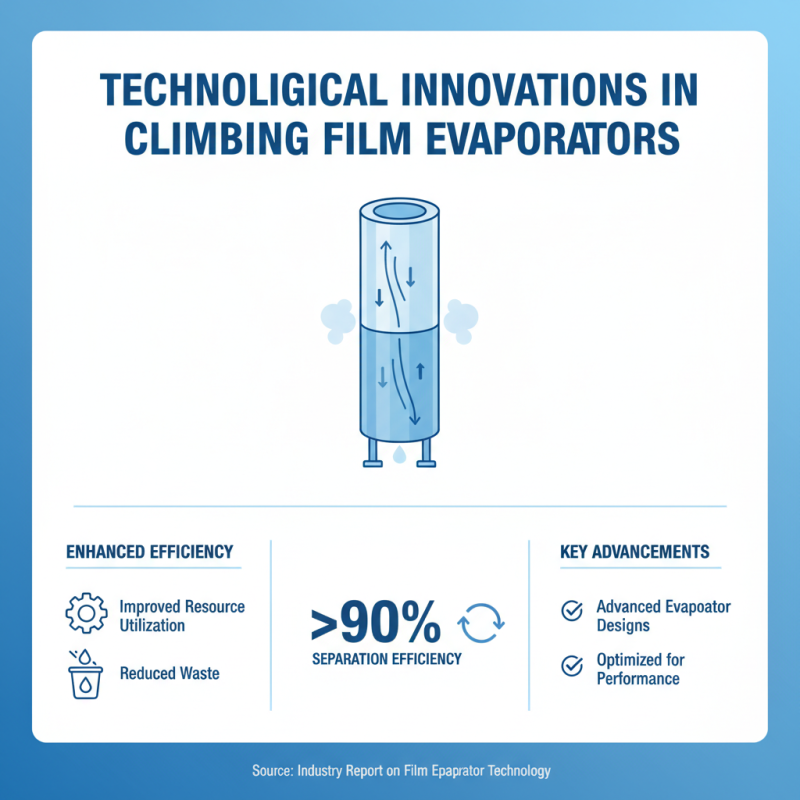
The development of climbing film evaporators has witnessed significant technological innovations in recent years. These advancements are aimed at enhancing efficiency and performance. According to a recent industry report, well-designed Climbing And Falling Film Evaporators can achieve separation efficiencies exceeding 90%. This is crucial for industries focused on improving resource utilization and reducing waste.
Heat transfer is a critical factor in the performance of these systems. New materials and advanced surface designs have led to improved heat transfer coefficients, boosting overall efficiency by 30%. However, the complexity of these designs can introduce challenges. Manufacturers must balance efficiency with maintainability. It’s essential to ensure that new innovations do not compromise the ease of operation.
Another area of innovation lies in automation. Automated control systems are becoming standard in modern evaporators. These systems optimize the operational parameters in real-time, ensuring consistent product quality. Yet, reliance on automation raises questions about system resilience. It's vital for manufacturers to provide adequate training for operators to effectively manage unexpected issues. Continuously monitoring performance will be key to making further improvements in climbing film evaporator technology.
Quality Control Measures in Manufacturing Processes
In the competitive landscape of evaporator manufacturing, quality control measures play a crucial role. Implementing stringent quality assessments ensures that products like the Double Effect Climbing Film Evaporator meet industry standards.
According to a recent study by the International Institute of Refrigeration, the efficiency of evaporators can vary widely. Manufacturers that lack robust quality control procedures report inefficiencies that can go up to 30%. This inefficiency not only affects product performance but also operational costs.
Advanced manufacturers employ several techniques to enhance quality, such as statistical process control (SPC) and total quality management (TQM). These methods help in identifying defects early in the production phase. A report from the American Society of Mechanical Engineers indicates that firms that adopted these measures saw a 20% reduction in product defects. However, not all factories fully embrace these techniques. Some still rely on outdated processes, leading to inconsistencies and dissatisfaction among clients.
In addition to proactive measures, fostering a culture of continuous improvement is essential. Regular training sessions for staff on the latest quality practices can yield better performance. Yet, many facilities overlook the importance of keeping up with industry advancements. The gap in knowledge can create vulnerabilities in quality assurance protocols, which can affect the reputation of manufacturers. With the right focus on quality control, the Double Effect Climbing Film Evaporator can emerge as a leader in optimal performance.
Case Studies: Successful Applications of Climbing Film Evaporators
Climbing film evaporators are gaining traction in various industries due to their efficiency. In many cases, they outperform traditional systems. For instance, in the food processing sector, a particular dairy plant adopted a climbing film evaporator for concentrating milk. The result was a notable decrease in energy consumption and improved product quality. This transformation highlighted the evaporator's ability to handle viscous materials effectively.
Another example can be found in chemical manufacturing. A facility implemented climbing film technology to enhance the concentration of specific solvents. The higher evaporation rates reduced processing time significantly. However, challenges included optimizing the temperature settings to avoid degradation of sensitive compounds. This reflection on operational details is crucial for achieving optimal performance.
The adaptability of climbing film evaporators shines in diverse applications. By comparing them with
Falling Film And Rising Film Evaporators, one can see the nuances in design choices. Each system has its strengths and weaknesses, and not every application suits a climbing film approach. Understanding these differences is essential for effective implementation and maximizing system efficiency.
Future Trends in Climbing Film Evaporator Technology and Market
In recent years, climbing film evaporator technology has advanced significantly. This evolution is driven by the
increasing demand for energy-efficient solutions in various
industries. Businesses are seeking methods to optimize their processes while minimizing environmental impact.
The future holds exciting possibilities, including developments in materials and design to enhance performance.
New trends indicate a move towards automation in evaporator systems.
Smart technologies can improve efficiency and reduce operational costs. Manufacturers are investing in research
to create more durable and efficient components. This will lead to evaporators that require less maintenance
and have lower energy consumption.
Tips: Regular maintenance can maximize performance. Monitor system parameters closely to identify any
inefficiencies early. Investing in employee training on new technologies is crucial for optimal operation.
Stay informed about industry advancements to remain competitive. These considerations will help businesses adapt
to changing market demands effectively.
Efficient Cooling Solutions: Exploring the Benefits of China U-Tube Single-Pass DX Evaporators from Trusted Suppliers
The demand for efficient cooling solutions has never been more critical, particularly in industries relying on precise temperature management. One of the leading innovations in this space is the U-Tube Single-Pass DX Evaporator. This advanced cooling system is designed to deliver rapid and effective cooling, optimizing the performance of both refrigeration and air conditioning systems. The U-tube configuration allows for improved refrigerant circulation, ensuring heat is absorbed efficiently from the medium being cooled.
One of the standout features of the U-Tube Single-Pass DX Evaporator is its ability to accommodate thermal expansion, which significantly reduces stress on the mechanical components. This design not only enhances reliability but also extends the service life of the evaporator, making it an exceptional choice for continuous operation environments. Constructed using high-quality materials and the latest technologies, this evaporator promises to meet and often exceed industry standards, providing peace of mind to users seeking durable and high-performance cooling solutions.
In environments where efficiency is paramount, the U-Tube Single-Pass DX Evaporator emerges as a trusted solution from reputable suppliers in China. Its innovative design and efficient functionality lead to optimal refrigerant distribution, ensuring that operations remain smooth and effective. Organizations looking to enhance their cooling capabilities would benefit significantly from integrating such reliable systems into their processes.
FAQS
: They enhance process efficiency in industries like food processing and pharmaceuticals.
They can reduce energy use by up to 30% compared to traditional methods.
Their design promotes fast thermal transfer and minimizes residence time for better product quality.
The initial investment and maintenance can be significant hurdles for them.
It can lead to a 15% reduction in operational costs, provided the setup is done correctly.
Improper setup or material choice can reduce benefits, so expertise is vital for maximizing potential.
Evaluate their technology, manufacturing capabilities, and quality assurance processes.
Good communication fosters partnerships and ensures that needs are understood and met.
Some may excel on paper but struggle in real-world applications, leading to frustrations.
Experienced factories understand nuances in technology and can manage production timelines better.
Conclusion
The article titled "Best OEM ODM Climbing Film Evaporator Factory for Optimal Performance" provides a comprehensive overview of climbing film evaporators and their significance in various industries. These advanced systems offer numerous benefits, including enhanced efficiency, reduced operating costs, and improved product quality. When selecting an OEM ODM factory, it is crucial to consider technological innovations, quality control measures, and the manufacturer's track record in successful applications.
Additionally, the article discusses future trends in climbing film evaporator technology, emphasizing the ongoing advancements that promise to further optimize performance and energy consumption. The case studies highlighted illustrate the effectiveness of climbing film evaporators in real-world settings, showcasing their adaptability and value across different sectors. Overall, the insights provided serve as a guide for industries seeking to leverage the advantages of climbing film evaporators while ensuring that they partner with top-tier manufacturers.